Alpha Homora V2 strategies for leveraged farmers
Updated 2026-08-16 · 4 min read
Reviewed by Alpha Homora V2 Info editorial desk ·
Strategy starts with the debt asset
The defining choice on Alpha Homora V2 is not the leverage slider but which asset you borrow. Borrowing a stablecoin against a volatile pair leaves you long that pair with amplified exposure. Borrowing the volatile asset instead partially offsets your exposure, because your debt grows with the same price that your collateral tracks. Understanding that single relationship separates farmers who use leverage as a yield tool from those who accidentally take a directional bet.
This flexibility is exactly what V2 added over V1, as covered in the V1 versus V2 comparison. It is also the foundation of every strategy below, so it is worth being explicit about the intended exposure before opening anything.
Stablecoin leveraged farming
The most conservative use of the protocol is farming a stable-to-stable pool with borrowed stablecoins. Divergence between two pegged assets is normally minimal, so impermanent loss stays small and higher multiples are defensible. The return comes from trading fees plus emissions on a large position, funded by comparatively cheap stablecoin debt.
The risk here is not price direction but peg failure. A stablecoin that loses its peg turns a supposedly correlated pair into a violently divergent one, and at high leverage the liquidation arrives quickly. Diversifying across pairs, avoiding thin or algorithmic stablecoins, and keeping leverage below the maximum are the mitigations that matter.
Delta-neutral constructions
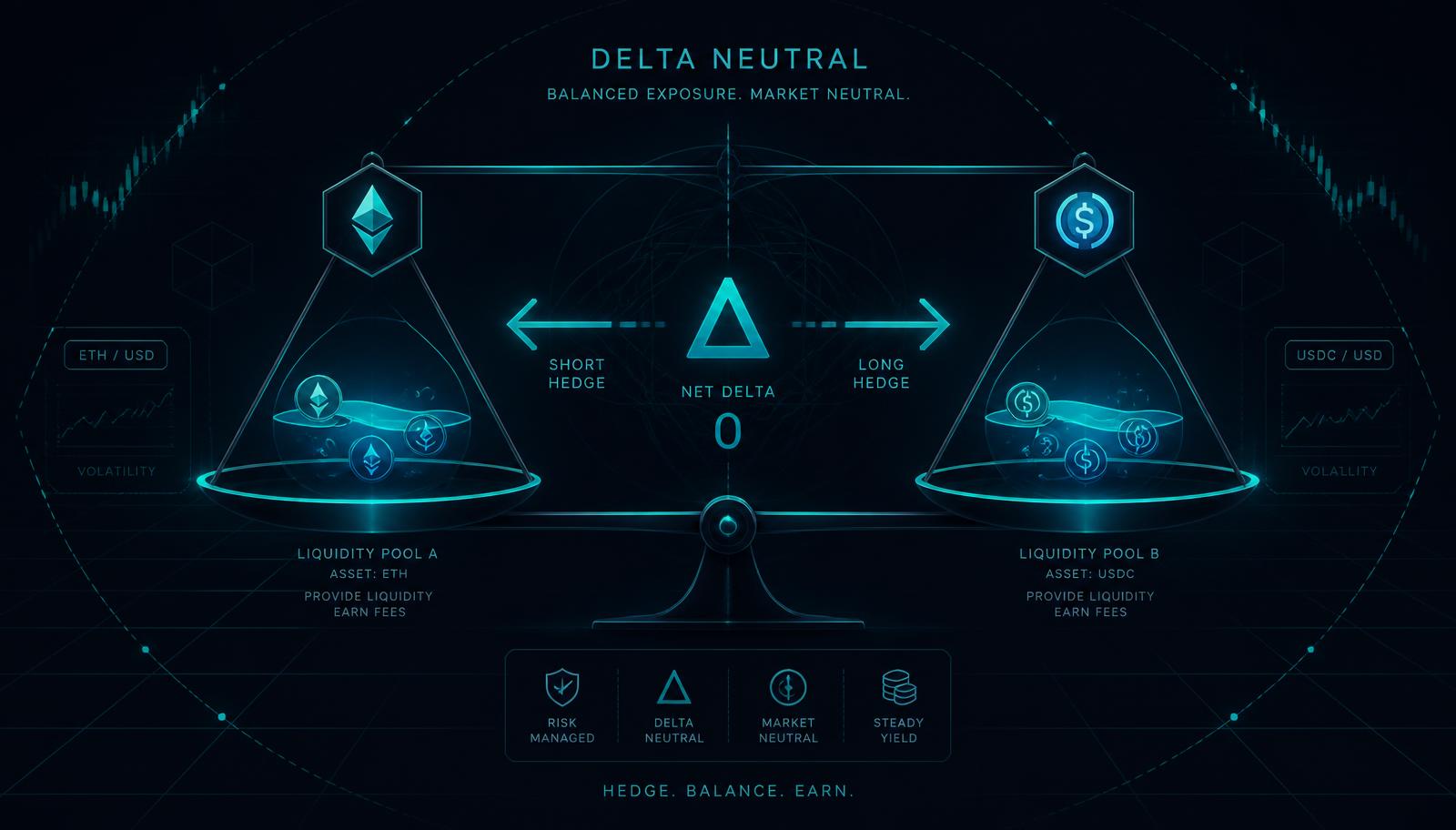
A delta-neutral position aims to earn yield while remaining insensitive to the volatile asset's price. On Alpha Homora V2 the classic approach is to open a leveraged position in a volatile-stable pool while borrowing the volatile asset in a proportion that offsets the exposure the LP position carries. Done correctly, the portfolio earns farming yield while price movement affects debt and collateral roughly equally.
Delta-neutral is not risk-neutral. The hedge ratio drifts as the AMM rebalances, so the position becomes progressively directional unless rebalanced, and each rebalance costs gas and slippage. Borrowing costs on the volatile asset are typically higher than on stablecoins, and impermanent loss does not vanish, it is merely offset. This is the most demanding strategy in the category and it rewards discipline rather than cleverness.
Conservative leverage as a strategy in itself
It is worth stating plainly that using 1.5x to 2x where the interface allows 7x is a legitimate, often superior strategy. Modest leverage moves the liquidation threshold far away, dramatically reduces the impact of a borrow-rate spike, and still meaningfully improves yield relative to unleveraged farming. Most blow-ups in this category come from farmers choosing a multiple based on the maximum available rather than on a plausible worst case.
- Define the adverse move you must survive, then pick leverage from it.
- Model every position at double the current borrow rate.
- Harvest on a schedule and realise emitted rewards.
- Keep reserve capital specifically for adding collateral.
- Write down the exit price before you open the position.
- Prefer deep pools so exiting in size does not move the market.
Exit planning is part of the strategy
Farmers spend far more effort on entry than on exit, which is backwards, because the exit determines the realised return. Unwinding a leveraged LP position means removing liquidity, swapping to repay debt and absorbing slippage on both legs, and all of that is worst precisely during the volatility that made you want to exit. Deciding the trigger in advance — a price level, a debt-ratio level, a change in borrow rate, or simply a date — converts a panic into a procedure.
Before deploying any of these approaches, make sure the risk material is fresh in mind: the risks and security guide covers what can go wrong structurally, and the safety article covers the due diligence to run first. Strategy without those two is a wish, not a plan.
Frequently asked questions about Alpha Homora V2
What is the safest Alpha Homora V2 strategy?
- Low-leverage farming of a deep stablecoin pair with stablecoin debt is generally the lowest-variance approach, though peg failure and smart-contract risk remain. No leveraged strategy is genuinely safe.
How does delta-neutral farming work on Alpha Homora V2?
- You open a leveraged position in a volatile-stable pool while borrowing the volatile asset in a proportion that offsets the position's exposure, so price movements affect collateral and debt roughly equally and you keep the farming yield.
Does delta-neutral eliminate impermanent loss?
- No. It offsets directional exposure but impermanent loss still exists, the hedge ratio drifts as the AMM rebalances, and rebalancing costs gas and slippage.
Should I borrow stablecoins or the volatile asset?
- Borrow stablecoins when you want amplified long exposure to the pair, and borrow the volatile asset when you want to reduce directional exposure. The choice defines the strategy far more than the leverage number does.
How much of my portfolio should go into leveraged farming?
- Only an amount whose total loss would be survivable, because smart-contract and liquidation risk can both result in complete loss of the position regardless of how carefully it was constructed.
Related reading
Alpha Homora V2 vs V1: what actually changed
Alpha Homora V2 vs V1 compared: multi-asset borrowing, position NFTs, spell contracts, oracle redesign and how the risk profile of each version differs.
Is Alpha Homora V2 safe? An honest assessment
Is Alpha Homora safe? An evidence-based look at Alpha Homora V2 audits, the 2021 exploit, governance and upgrade risk, and a practical safety checklist for users.
Alpha Homora V2 fees and realistic APY
Alpha Homora V2 fees and APY explained: borrowing interest, protocol fees, reward emissions and impermanent loss, and how to calculate realistic net returns at leverage.
Alternativas a Alpha Homora V2 en 2026
Alternativas a Alpha Homora V2 para yield farming apalancado: qué buscar, en qué se diferencian los diseños modernos y cómo trasladar lo aprendido a otro protocolo.
Sources and further reading
The claims on this page are checked against the following primary and independent sources.
- Alpha Homora V2 app and protocol documentation
Primary source for pools, leverage limits and debt ratio mechanics.
- Alpha Venture DAO blog
Official announcements, post-mortems and product updates from the team behind the protocol.
- Rekt — Alpha Finance exploit analysis
Independent write-up of the February 2021 Alpha Homora V2 / Iron Bank incident.
- DefiLlama — Alpha Homora TVL history
Third-party data on total value locked and chain distribution over time.
- Chainlink price feeds documentation
Background on the oracle design that leveraged positions depend on for liquidation pricing.