Alpha Homora V2 fees and realistic APY
Updated 2026-08-16 · 4 min read
Reviewed by Alpha Homora V2 Info editorial desk ·
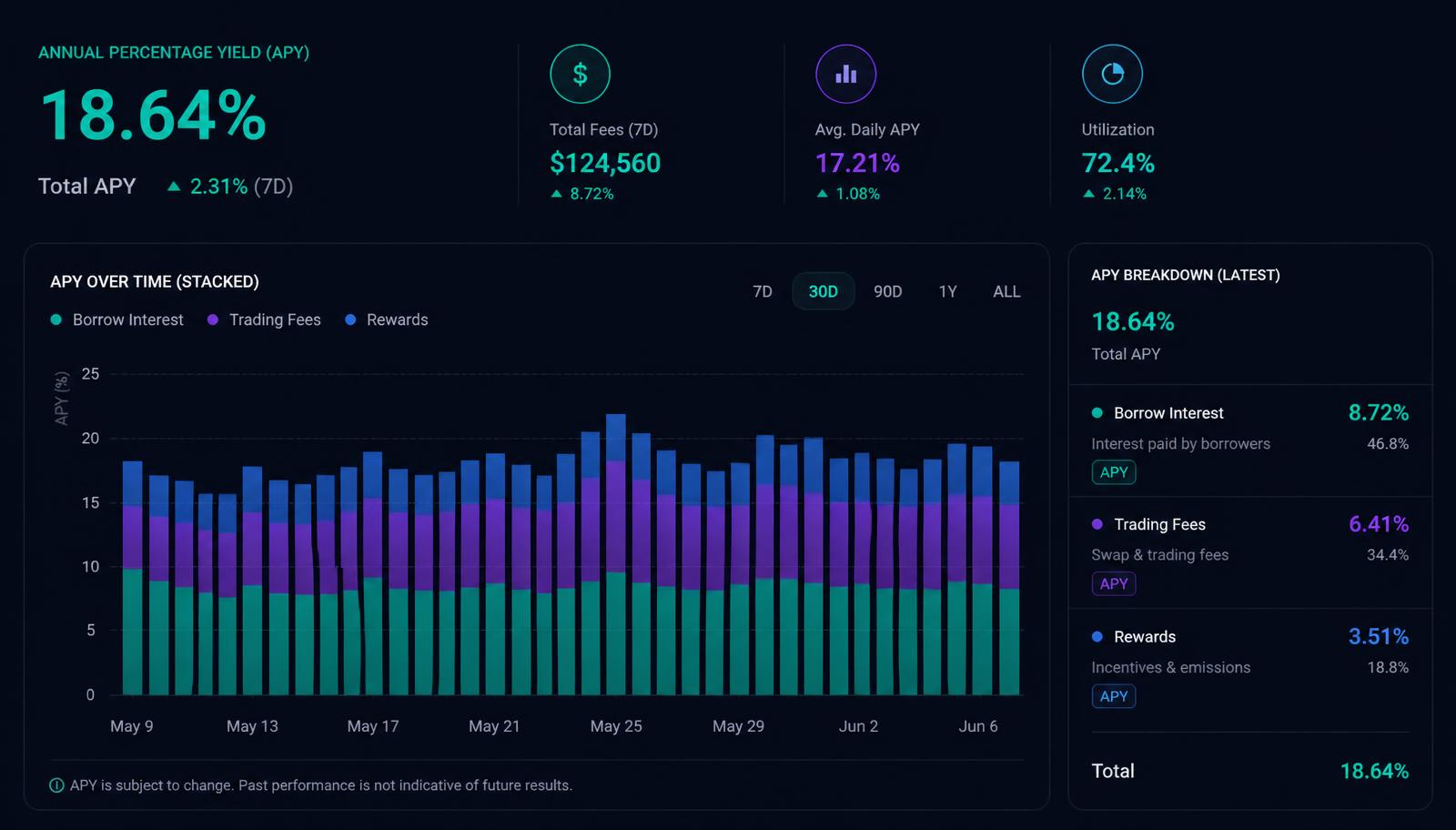
Why headline APY is never what you earn
Every leveraged farming interface shows a large number, and every one of those numbers is a projection built on assumptions that expire quickly. The advertised APY of a pool typically combines trading-fee income with reward-token emissions valued at the current price, annualised from a recent window. Neither component is guaranteed to persist for a day, let alone a year.
On top of that projection, a leveraged farmer subtracts borrowing interest on the debt, any protocol fee on rewards or on borrowing, gas costs for opening, harvesting and closing, and the expected impermanent loss of the pair. What remains is the realised return, and the distance between it and the headline number grows with leverage because the subtractions scale too.
The components, one by one
Borrowing interest is the largest and most volatile cost. Rates follow utilisation: when many farmers want to borrow the same asset, the rate rises sharply, and it can do so within hours. A position modelled at a 5 percent borrow rate can be paying double that in a busy week, which is why stress-testing at elevated rates is more useful than optimising the entry number.
Protocol fees are smaller but structural — historically a share of harvested rewards or a spread on interest, directed to the treasury. Gas is a fixed cost that matters enormously for small positions and is nearly irrelevant for large ones; on Ethereum mainnet, a strategy requiring frequent harvesting can be uneconomic below a certain size.
Impermanent loss is the component most often ignored because it is not a line item anywhere. It is real nonetheless: it shows up as a smaller collateral value at exit than the price change alone would imply, and at leverage it hits equity by the multiplier. The mechanics and worked numbers are in leveraged yield farming explained.
A calculation template
The useful formula is straightforward. Net return on equity equals leverage times the gross farm yield, minus leverage minus one times the borrow rate, minus fees, minus expected impermanent loss times leverage. Concretely, at 3x with a 12 percent gross yield and a 7 percent borrow rate: 36 percent minus 14 percent equals 22 percent before fees and divergence loss. Subtract 2 percent of fees and an expected 4 percent of amplified impermanent loss and roughly 16 percent remains.
Now run the same template with pessimistic inputs, which is the step most people skip. Gross yield at 8 percent because emissions cooled, borrow at 12 percent because utilisation spiked, and 8 percent amplified divergence loss: 24 percent minus 24 percent minus fees minus 8 percent leaves a clearly negative result. Both scenarios are plausible in the same quarter, and the position that survives is the one sized for the second.
Reward tokens and the decay problem
A large share of advertised yield in farming is paid in an emitted token. Its price is under continuous sell pressure from farmers realising income, so the value of the reward stream tends to decline over the life of a position unless demand grows to match emissions. Two farmers with identical positions can have very different outcomes purely because one harvested and sold weekly while the other let rewards accumulate.
The practical implication is that yield in emitted tokens should be discounted, not taken at face value, and harvested on a schedule that matches gas costs. Durable yield — trading fees on a genuinely active pool — deserves more weight in the decision than a headline number inflated by temporary emissions, a theme continued in the strategies article.
Frequently asked questions about Alpha Homora V2
What fees does Alpha Homora V2 charge?
- The main cost is borrowing interest paid to the lending pool, which floats with utilisation. On top of that the protocol has historically taken a share of harvested rewards or an interest spread for the treasury, and users pay network gas for opening, harvesting and closing positions.
What APY could I realistically expect?
- There is no fixed number. Realistic net APY equals leverage times gross farm yield minus borrowing cost on the borrowed portion minus fees minus amplified impermanent loss, and each input changes continuously. Modelling optimistic and pessimistic cases is more useful than any single figure.
Why did my yield drop without any price movement?
- Most often because the borrow rate rose with utilisation, or because reward emissions decreased or the reward token's price fell. All three reduce net return while the pair's price is unchanged.
Does higher leverage always mean higher APY?
- No. Leverage multiplies gross yield but also multiplies borrowing cost and impermanent loss. Once the borrow rate approaches the farm yield, higher leverage lowers net return while raising liquidation risk.
How often should I harvest rewards?
- Frequently enough that reward-token price decay does not erode your income, but not so frequently that gas costs exceed the harvest. On low-fee chains that can be weekly; on Ethereum mainnet it depends heavily on position size.
Related reading
Alpha Homora V2 vs V1: what actually changed
Alpha Homora V2 vs V1 compared: multi-asset borrowing, position NFTs, spell contracts, oracle redesign and how the risk profile of each version differs.
Is Alpha Homora V2 safe? An honest assessment
Is Alpha Homora safe? An evidence-based look at Alpha Homora V2 audits, the 2021 exploit, governance and upgrade risk, and a practical safety checklist for users.
Alpha Homora V2 strategies for leveraged farmers
Practical Alpha Homora V2 strategies: stablecoin leveraged farming, delta-neutral positions, conservative leverage sizing, harvesting discipline and exit planning.
Alternativas a Alpha Homora V2 en 2026
Alternativas a Alpha Homora V2 para yield farming apalancado: qué buscar, en qué se diferencian los diseños modernos y cómo trasladar lo aprendido a otro protocolo.
Sources and further reading
The claims on this page are checked against the following primary and independent sources.
- Alpha Homora V2 app and protocol documentation
Primary source for pools, leverage limits and debt ratio mechanics.
- Alpha Venture DAO blog
Official announcements, post-mortems and product updates from the team behind the protocol.
- Rekt — Alpha Finance exploit analysis
Independent write-up of the February 2021 Alpha Homora V2 / Iron Bank incident.
- DefiLlama — Alpha Homora TVL history
Third-party data on total value locked and chain distribution over time.
- Chainlink price feeds documentation
Background on the oracle design that leveraged positions depend on for liquidation pricing.