Alpha Homora V2 vs V1: what actually changed
Updated 2026-08-16 · 3 min read
Reviewed by Alpha Homora V2 Info editorial desk ·
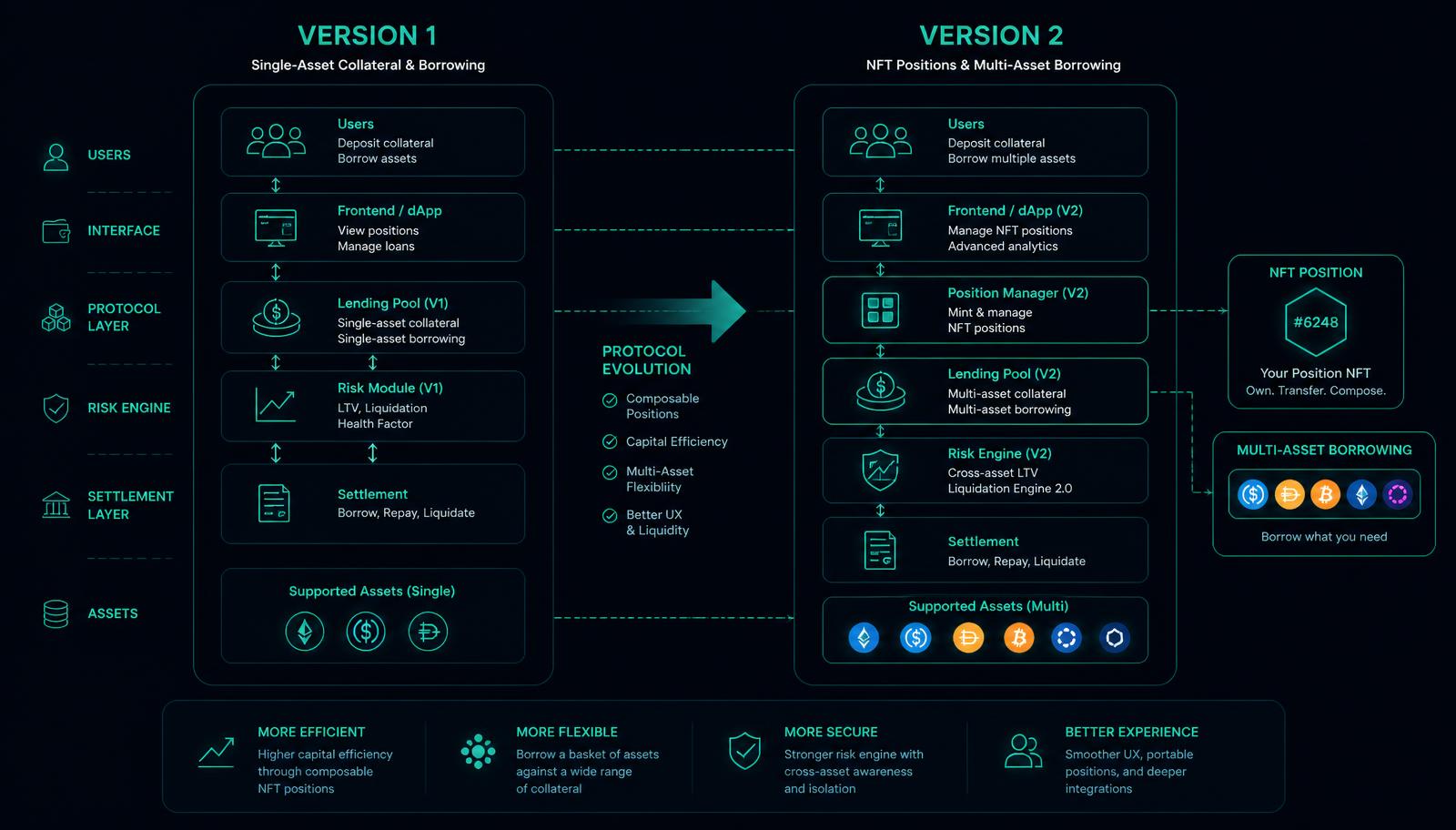
Two generations, two design philosophies
Alpha Homora V1 was a proof that leveraged yield farming could work on-chain. It let users borrow ETH against their farming position and deploy the combined capital into supported pools. The scope was narrow by design: one borrowable asset, a limited set of integrations, and a position model that treated all users' collateral in a relatively uniform way. That narrowness was a feature during the bootstrapping phase, because it kept the attack surface small and the mental model simple.
Alpha Homora V2 was built for expressiveness. Multi-asset lending pools meant a farmer could borrow whichever side of a pair their strategy required — borrow stablecoins against a volatile position, or borrow the volatile asset to construct a delta-neutral book. Position NFTs made each position an individual object with its own collateral, debt and lifecycle. Spell contracts turned each integration into a narrow, audited interface instead of bespoke logic scattered through the core.
The differences that matter in practice
For a user, the most consequential change is borrowing flexibility. In V1, strategy design was constrained to what ETH-denominated debt allowed, which meant every position carried implicit ETH exposure. In V2 the debt asset became a strategic choice, and that single change unlocked stablecoin-funded farming and the delta-neutral constructions described in the strategies article.
The second change is granularity. Because a V2 position is an NFT with its own accounting, users can hold several positions with different pairs and leverage levels simultaneously without one contaminating another, and each can be managed, transferred or liquidated independently. The third is the oracle redesign: V2 priced LP collateral using fair-value maths rather than instantaneous reserves, closing a manipulation vector that had already been exploited elsewhere in DeFi.
Did V2 make things safer?
In some dimensions clearly yes: the oracle work removed a known class of attack, and spells constrained what a position could do far more tightly than ad-hoc integration code. In other dimensions no. More assets, more integrations and a partnership with an external money market meant more seams, and it was exactly a seam — the Iron Bank integration — that produced the February 2021 exploit described in the risks and security guide.
This is the honest generalisation: expressiveness and safety trade against each other in DeFi. Every additional capability is another interface that must be correct under adversarial conditions. V2 is a better protocol than V1 by almost any functional measure and simultaneously a larger target, which is why an evaluation should never stop at 'the newer version is safer'.
Which version should you study?
For learning purposes, V2 is the more useful object. Its architecture — internal lending pools, position-level health, whitelisted strategy contracts, fair-value collateral oracles — is the template that later leverage protocols copied, so time spent understanding it transfers directly. V1 is mainly interesting as historical context showing how the category began and which constraints the second version was designed to remove.
If you are approaching this material fresh, read what is Alpha Homora V2 first for the definitions, then how Alpha Homora V2 works for the mechanics, and come back to this comparison. The differences make far more sense once the V2 machinery is familiar.
Frequently asked questions about Alpha Homora V2
What is the main difference between Alpha Homora V1 and V2?
- V1 allowed borrowing ETH only, while V2 introduced multi-asset lending pools so a farmer can borrow whichever asset the strategy needs, along with position NFTs, spell contracts and a redesigned LP oracle.
Are positions from V1 and V2 compatible?
- No. They are separate deployments with different contracts and accounting models. A V1 position is not migrated automatically into V2.
Is Alpha Homora V2 safer than V1?
- Safer in specific ways, notably oracle design and constrained integrations, but it also has a larger attack surface. The 2021 exploit occurred in V2's integration layer, so 'newer' does not mean 'risk-free'.
Why did Alpha Homora add position NFTs?
- Representing each position as an NFT makes it individually accountable and transferable, so users can run multiple independent strategies and the protocol can manage collateral, debt and liquidation per position.
Does V2 support more chains than V1?
- The two versions were deployed across different networks over time, including Ethereum, Avalanche, Fantom and Optimism for V2 and Binance Smart Chain for V1. Availability changed, so verify current deployments before use.
Related reading
Is Alpha Homora V2 safe? An honest assessment
Is Alpha Homora safe? An evidence-based look at Alpha Homora V2 audits, the 2021 exploit, governance and upgrade risk, and a practical safety checklist for users.
Alpha Homora V2 fees and realistic APY
Alpha Homora V2 fees and APY explained: borrowing interest, protocol fees, reward emissions and impermanent loss, and how to calculate realistic net returns at leverage.
Alpha Homora V2 strategies for leveraged farmers
Practical Alpha Homora V2 strategies: stablecoin leveraged farming, delta-neutral positions, conservative leverage sizing, harvesting discipline and exit planning.
Alternativas a Alpha Homora V2 en 2026
Alternativas a Alpha Homora V2 para yield farming apalancado: qué buscar, en qué se diferencian los diseños modernos y cómo trasladar lo aprendido a otro protocolo.
Sources and further reading
The claims on this page are checked against the following primary and independent sources.
- Alpha Homora V2 app and protocol documentation
Primary source for pools, leverage limits and debt ratio mechanics.
- Alpha Venture DAO blog
Official announcements, post-mortems and product updates from the team behind the protocol.
- Rekt — Alpha Finance exploit analysis
Independent write-up of the February 2021 Alpha Homora V2 / Iron Bank incident.
- DefiLlama — Alpha Homora TVL history
Third-party data on total value locked and chain distribution over time.
- Chainlink price feeds documentation
Background on the oracle design that leveraged positions depend on for liquidation pricing.