Leveraged yield farming with Alpha Homora V2, explained
Updated 2026-08-16 · 5 min read
Reviewed by Alpha Homora V2 Info editorial desk ·
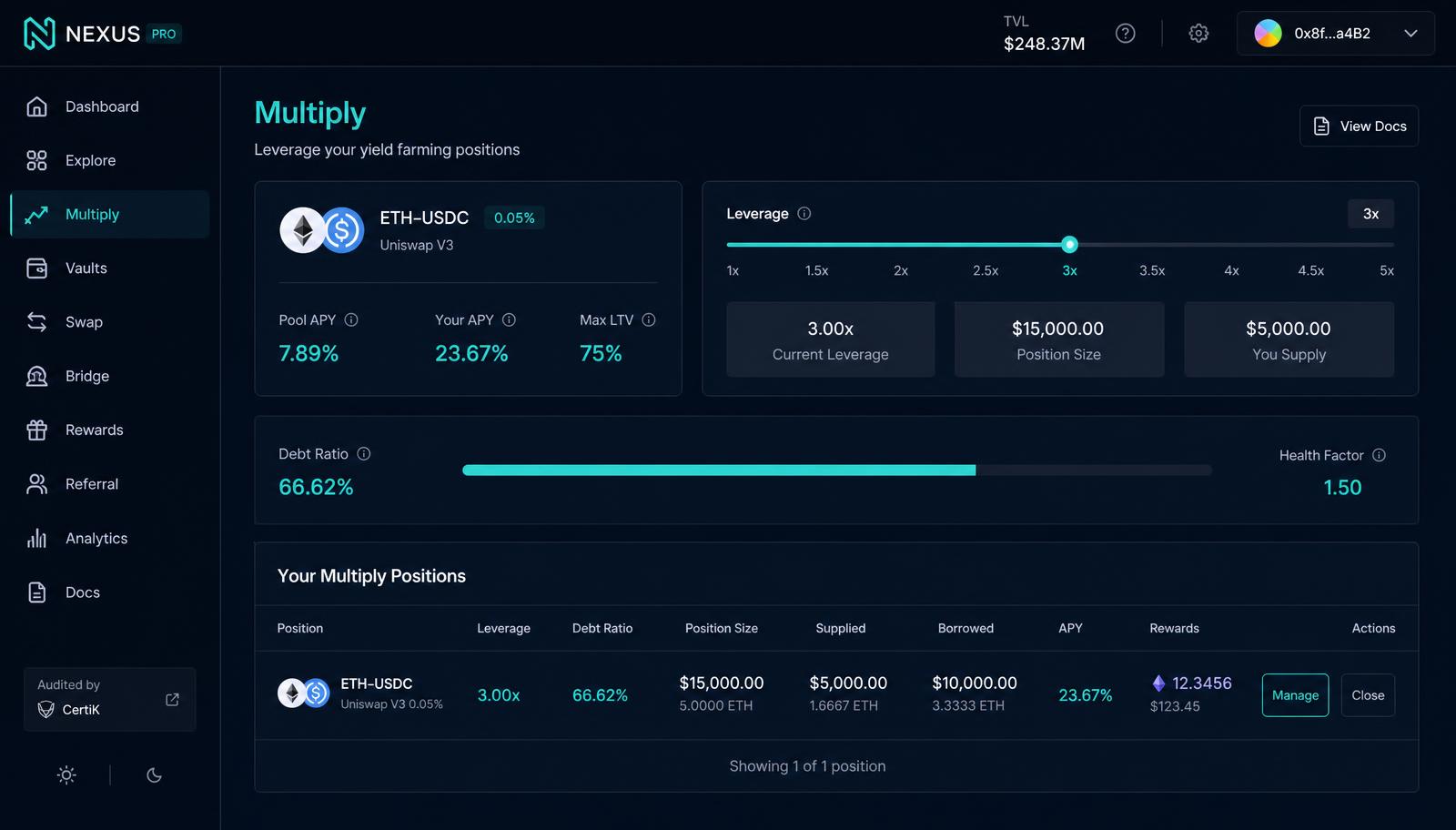
What leveraged yield farming actually is
Ordinary yield farming means providing liquidity to a pool and collecting trading fees plus reward emissions. Leveraged yield farming adds borrowed capital to that same activity. On Alpha Homora V2 the borrowing happens inside the protocol, so the farmer never handles the borrowed tokens; they simply see a larger position and a debt balance attached to it.
The appeal is arithmetic. If a pool pays 12 percent annualised and borrowing costs 5 percent, then at 3x leverage the equity earns roughly three times the 12 percent gross yield minus interest on the two borrowed units, which works out substantially higher than 12 percent. The trap is that the same multiplier applies to everything else: impermanent loss, price drawdown and any error in your assumptions.
Choosing the pool before choosing the leverage
Most avoidable losses in leveraged farming come from pairing high leverage with a pool that cannot support it. Correlation is the first filter. A stablecoin-to-stablecoin pool has minimal divergence, so its collateral value is stable and high multiples are defensible. A pool pairing a volatile reward token with a stablecoin has enormous divergence potential, and leverage there is closer to a directional bet than to a yield strategy.
The second filter is yield durability. A farm advertising a very high APY is usually paying it in a token with heavy emissions and thin liquidity, meaning the reward price tends to fall as you earn it. Ask where the yield comes from: trading fees are durable, emissions are temporary, and points or promotional boosts are neither. The fees and APY article breaks these components apart.
The third filter is exit liquidity. A leveraged position must be unwound through the same AMM it entered, so a pool that is thin relative to your position will cost you slippage twice and can make liquidation dramatically worse than the theoretical numbers suggest.
A worked example
Suppose a farmer supplies 10,000 dollars of collateral into a stable pair at 3x leverage. The protocol lends 20,000 dollars, producing a 30,000 dollar position. If the pool yields 10 percent gross and the borrow rate is 6 percent, gross farming income is 3,000 dollars a year while interest is 1,200 dollars, leaving 1,800 dollars on 10,000 dollars of equity — about 18 percent, before fees and impermanent loss.
Now change one assumption. If borrow utilisation spikes and the rate rises to 11 percent, interest becomes 2,200 dollars and the net return collapses to 8 percent, below the unleveraged 10 percent. Leverage did not just fail to help; it actively hurt, because the farmer took liquidation risk for a worse outcome. This sensitivity to borrowing cost is the single most underappreciated factor in leveraged yield farming.
Add a price move and the picture sharpens further. On a volatile pair, a 30 percent divergence between the two assets produces roughly 1.5 percent impermanent loss on the position; at 3x that is about 4.5 percent of equity, and at 6x roughly 9 percent, on top of whatever the directional exposure did. Understanding this before opening is far cheaper than discovering it afterwards.
Sizing leverage responsibly
A practical approach is to work backwards from the liquidation price rather than forwards from the desired yield. Decide what adverse move you consider plausible over your intended holding period — not the average week, but a bad one — and choose leverage such that the liquidation threshold sits comfortably beyond it. On volatile pairs that usually means far lower multiples than the maximum the interface allows.
Second, treat maximum leverage as a system limit, not a recommendation. The protocol permits a level at which liquidation is merely unlikely under normal conditions; DeFi's history is a catalogue of abnormal conditions. Third, size positions so that a full loss is survivable at the portfolio level, because smart-contract risk does not care how carefully you chose your leverage.
- Prefer correlated pairs when using higher multiples.
- Model the position at double the current borrow rate.
- Set an add-collateral price and an exit price before opening.
- Harvest and de-risk rewards rather than letting them ride.
- Never assume the maximum permitted leverage is the intended leverage.
Break-even and when leverage is simply wrong
There is a clean break-even condition: leverage adds value only while the net farm yield exceeds the borrowing cost of the asset you borrow, after accounting for expected impermanent loss. When borrowing costs approach the farm's durable yield, the correct leverage is 1x — that is, no leverage at all — and the honest conclusion is to farm unleveraged or not to farm.
That conclusion is unpopular but it is the whole point of understanding the mechanics. Alpha Homora V2 gave farmers a precise, transparent tool; whether the tool improves an outcome depends entirely on inputs that change hourly. Before committing, review the risks and security guide and the strategies article so that both the upside and the failure modes are explicit.
Frequently asked questions about Alpha Homora V2
What is leveraged yield farming on Alpha Homora V2?
- It is providing liquidity to a pool using both your own capital and assets borrowed from the protocol, so that farm rewards apply to a larger position while you pay interest on the borrowed portion.
How much leverage is safe?
- There is no universally safe number. Correlated stablecoin pairs tolerate higher multiples than volatile pairs, and the appropriate level is the one where a plausible adverse move still leaves you far from the liquidation threshold.
How does leverage affect impermanent loss?
- Impermanent loss applies to the entire position, not just your equity, so it is effectively multiplied by the leverage factor. A 1.5 percent divergence loss becomes roughly 4.5 percent of equity at 3x.
Can I lose more than my deposit?
- The protocol is designed so liquidation closes positions before debt exceeds collateral, meaning your loss is normally capped at your equity. Extreme volatility, oracle failure or exploits can break that assumption and create bad debt.
What happens if borrowing rates rise after I open a position?
- Your interest cost rises immediately because rates float with utilisation. A position that was profitable can turn negative without any price movement, which is why stress-testing at higher rates matters.
Is leveraged farming better than just holding?
- Only when durable yield clearly exceeds borrowing cost and expected impermanent loss, and only if you can tolerate liquidation and contract risk. Frequently the honest answer is no.
Related reading
What is Alpha Homora V2?
What is Alpha Homora V2? A clear explanation of the leveraged yield farming protocol by Alpha Venture DAO: origins, design, supported chains and who it was built for.
How Alpha Homora V2 works: mechanics of the protocol
How does Alpha Homora V2 work? Step-by-step mechanics of HomoraBank, ibTokens, spell contracts, oracles, debt ratio and liquidation in leveraged yield farming.
Alpha Homora V2 risks and security
Is Alpha Homora V2 safe? A frank review of smart-contract risk, the 2021 Iron Bank exploit, oracle manipulation, liquidation and bad-debt risk for lenders and farmers.
Alpha Homora V2 vs V1: what actually changed
Alpha Homora V2 vs V1 compared: multi-asset borrowing, position NFTs, spell contracts, oracle redesign and how the risk profile of each version differs.
Sources and further reading
The claims on this page are checked against the following primary and independent sources.
- Alpha Homora V2 app and protocol documentation
Primary source for pools, leverage limits and debt ratio mechanics.
- Alpha Venture DAO blog
Official announcements, post-mortems and product updates from the team behind the protocol.
- Rekt — Alpha Finance exploit analysis
Independent write-up of the February 2021 Alpha Homora V2 / Iron Bank incident.
- DefiLlama — Alpha Homora TVL history
Third-party data on total value locked and chain distribution over time.
- Chainlink price feeds documentation
Background on the oracle design that leveraged positions depend on for liquidation pricing.